
Hiring a tree feller in Pretoria isn’t the same as hiring someone to mow your lawn or trim a hedge. You’re hiring someone to control the fall of thousands of kilograms of timber, often within metres of your home, your vehicles, your neighbour’s property, and your family.
Over the years, I’ve noticed that homeowners tend to focus on one thing above everything else: price. Unfortunately, that single decision often determines whether the job ends with a neatly cleaned garden or a collapsed roof. Super Green can assist with all your tree felling and stump grinding needs
If you remember only one thing from this article, let it be this:
The cheapest tree felling quote is often the most expensive decision you’ll ever make.
Here are the questions I believe every homeowner should ask before hiring a tree feller.
Why Asking Questions Matters
Most people assume tree felling is simply cutting down a tree with a chainsaw. It isn’t.
Professional tree removal is a carefully planned engineering exercise involving structural assessment, controlled rigging, safety procedures, equipment selection, and risk management.
The quality of the answers you receive during the quotation stage will usually tell you exactly what kind of contractor you’re dealing with.
Read our latest blog on: How Much Should Tree Trimming Cost?
Question 1: Can Your Insurance Broker Email Me Your Public Liability Insurance Certificate Today?
This is always my first recommendation.
Don’t ask whether they have insurance. Ask whether their insurance broker can email you a current certificate directly.
Professional companies won’t hesitate.
A good answer sounds something like:
- Absolutely.
- Give me your email address.
- I’ll ask our broker to send it immediately.
A bad answer usually sounds like:
- Don’t worry, we’re covered.
- I have paperwork somewhere in the bakkie.
- We’ve never had a problem before.
If they can’t immediately prove they have current Public Liability Insurance, move on.
Why This Question Is So Important
I often think about one of the industry’s classic cautionary tales.
A homeowner hired an uninsured “bakkie brigade” because their quote was less than half the price of professional arborists.
The crew attempted to fell a massive Blue Gum tree in one piece instead of dismantling it safely in sections.
They misjudged the lean.
The tree twisted.
It crashed through the homeowner’s tiled roof and destroyed the boundary wall.
The contractors packed up their tools and disappeared.
Because they had no Public Liability Insurance, the homeowner was left with more than R150,000 worth of repairs.
Saving money on the quote became the most expensive decision they ever made.
Question 2: Will You Be Using Sectional Dismantling or Dropping the Tree in One Go?
The answer tells you everything about how the contractor approaches risk.
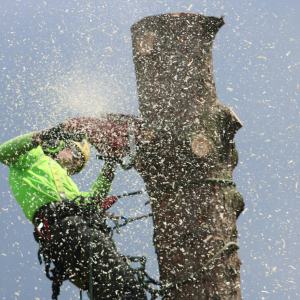
Large trees near houses should almost always be dismantled piece by piece using controlled rigging systems.
Professionals understand that gravity needs to be managed.
Cowboys simply hope gravity behaves itself.
A Good Answer
- We’ll climb the tree.
- We’ll use safety harnesses.
- We’ll lower branches individually using rigging ropes.
- Nothing will be allowed to free-fall onto your property.
A Bad Answer
- We’ll notch it at the bottom.
- We’ll tie a rope to the bakkie.
- We’ll pull it away from the house.
Those are not reassuring answers.
They’re warning signs.
Question 3: What Safety Equipment Does Your Crew Wear?
Professional companies don’t negotiate with safety.
Every crew member should arrive wearing appropriate PPE.
- Hard hats
- Steel-toe boots
- Eye protection
- High-visibility clothing
- Chainsaw protective chaps
- Safety harnesses for climbers
If workers arrive wearing takkies, shorts and sunglasses, they’re telling you exactly how seriously they take safety.
Unfortunately, companies that cut corners on safety usually cut corners everywhere else too.
Question 4: Do You Use Climbing Spikes When You’re Only Pruning Trees?
This is one of my favourite questions because almost nobody asks it.
Professionals know that climbing spikes should only be used on trees being removed.
Using spikes during pruning punches dozens of wounds into the trunk, opening the tree to pests and disease.
If someone tells you they spike every tree because it’s faster, they’ve just shown you they prioritise speed over tree health.
Question 5: Who Will Actually Supervise My Job?
Many homeowners assume the experienced person who provides the quote will also supervise the work.
That isn’t always true.
Ask whether:
- The owner will be present.
- A qualified supervisor will remain on site.
- Casual labourers will be left alone.
If the contractor says they’ll simply drop the workers off and return later, I’d be very concerned.
Question 6: How Do You Protect My Property During The Job?
This question quickly separates experienced arborists from general labourers.
Ask how they plan to protect:
- Your roof
- Your swimming pool
- Your paving
- Your lawn
- Your neighbour’s property
- Vehicles
- Boundary walls
A professional immediately starts talking about rigging, drop zones, spotters, barriers and controlled lowering techniques.
An amateur usually replies:
“Don’t worry.”
That isn’t a safety plan.
Question 7: What Qualifications Do Your Climbers Have?
Tree climbing isn’t something someone simply learns after buying a chainsaw.
Professional climbers invest in training that covers:
- Advanced climbing techniques
- Aerial rescue
- Rigging systems
- Chainsaw safety
- Modern arboriculture
If someone tells you qualifications are just pieces of paper, I’d question everything else they’ve told you.
What Red Flags Tell Me To Walk Away Immediately?
After observing this industry for years, I’ve noticed the warning signs often appear long before the chainsaws come out.
Drive-By Inspections
If someone quotes from one photograph or barely looks at the tree before giving a price, that’s a concern.
A proper inspection should include:
- Checking the trunk
- Inspecting the root flare
- Looking for decay
- Assessing nearby buildings
- Planning the safest removal method
Cash Deposits For Fuel
Professional companies have accounts with suppliers.
If someone needs your deposit simply to buy fuel or hire equipment for an ordinary residential job, I’d be asking serious questions.

WhatsApp Quotes With No Detail
If your entire quotation says:
“Tree removal – R6,000”
then you’ve learned almost nothing.
A professional quotation should clearly explain exactly what is included.
Poorly Maintained Equipment
Old leaking vehicles.
Dull chains.
Rusty equipment.
These things matter.
How someone treats their equipment is usually how they’ll treat your property.
Generic Google Reviews
I always recommend reading reviews properly.
Real reviews usually mention specific situations.
- Branches lowered safely over a pool.
- Excellent cleanup.
- Difficult access handled professionally.
- Damage avoided around roofs.
Twenty identical five-star reviews saying “Great service” don’t tell you very much.
What Should A Professional Tree Felling Quote Include?
A proper quotation should leave nothing open to interpretation.
It should clearly state:
- Number and species of trees
- Tree locations
- Removal methodology
- Rigging requirements
- Safety measures
- Cleanup
- Waste removal
- Company registration details
- VAT status
- Insurance information
The Hidden Costs Many Cheap Quotes Leave Out
These are the items I most often see added after work has already started.
- Removing the timber after cutting it down.
- Branch chipping.
- Green waste disposal.
- Stump grinding.
- Final cleanup.
- Difficult access charges.
- Cherry-picker or crane hire.
- VAT.
If those costs aren’t listed upfront, ask why.
A Cheap Quote That Became An Expensive Disaster
One example perfectly illustrates why comparing only prices is dangerous.
A homeowner accepted a R3,500 quote to remove a large dead Pine tree beside a boundary wall and a neighbouring thatched lapa.
The contractor underestimated the difficulty.
They damaged the wall.
Halfway through the job they realised the tree was unsafe to climb.
They demanded additional money to hire a cherry picker.
The homeowner had little choice.
The tree was already half dismantled.
By the end of the project the costs included:
- Initial tree felling
- Cherry-picker hire
- Boundary wall repairs
- Stump grinding
- Waste disposal
The original R3,500 quote eventually became an R18,500 project.
A reputable arborist had originally quoted around R9,500 to complete everything safely from the start.
My Biggest Lesson After Watching This Industry For Years
If I could leave every homeowner with one piece of advice, it would be this:
A tree felling quote doesn’t buy you the removal of wood.
It buys you the precise control of gravity.
Over the years, my view of this trade has completely changed.
I no longer see tree felling as manual labour.
I see it as surgery.
A mature tree weighing several tonnes is a living structure positioned beside your biggest financial investment.
Hiring an uninsured contractor simply because they own a chainsaw is like hiring someone with a sharp kitchen knife to perform major surgery on your dining room table.
The equipment doesn’t make the professional.
The planning does.
The training does.
The safety procedures do.
Most importantly, respect for the risk does.
You cannot negotiate with gravity.
Once the final cut is made, there is no pause button, no undo feature and no second chance.
At that exact moment, the contractor’s true competence is revealed.
Final Thoughts
Never let the fear of paying a higher price blind you to the catastrophic cost of a cheap mistake.
A professional arborist may make you pause when you read their detailed, itemised quotation.
A dangerous contractor may make your heart stop when you watch your tree crash through your roof.
Protect your home.
Protect your family.
Respect the danger involved.
When choosing a tree feller, don’t buy the cheapest quote.
Buy experience, planning, insurance, professionalism and the confidence that when gravity takes over, everything has already been carefully controlled.